A global simulation cannot afford global communication.
Large-scale simulations cannot run on a single machine.
That's not really debatable.
Eventually you hit limits in:
- CPU
- Memory
- I/O bandwidth
The simulation has to be distributed.
- ✅ Problem solved? Not quite.
You have merely exchanged one bottleneck for another.
The communication problem
Once the simulation spans multiple machines, communication becomes a big problem.
- ❌ Every node talking to every other node
- ❌ Global state synchronization
- ❌ Global data broadcasts
- ❌ Communication costs growing faster than compute capacity
At that point, adding more servers can actually make things worse.
Decades of distributed systems research have produced countless approaches to similar problems.
But there is no one-size-fits-all solution.
Every architecture ultimately chooses which costs it is willing to pay.
HiveShard's approach
HiveShard approaches this problem differently:
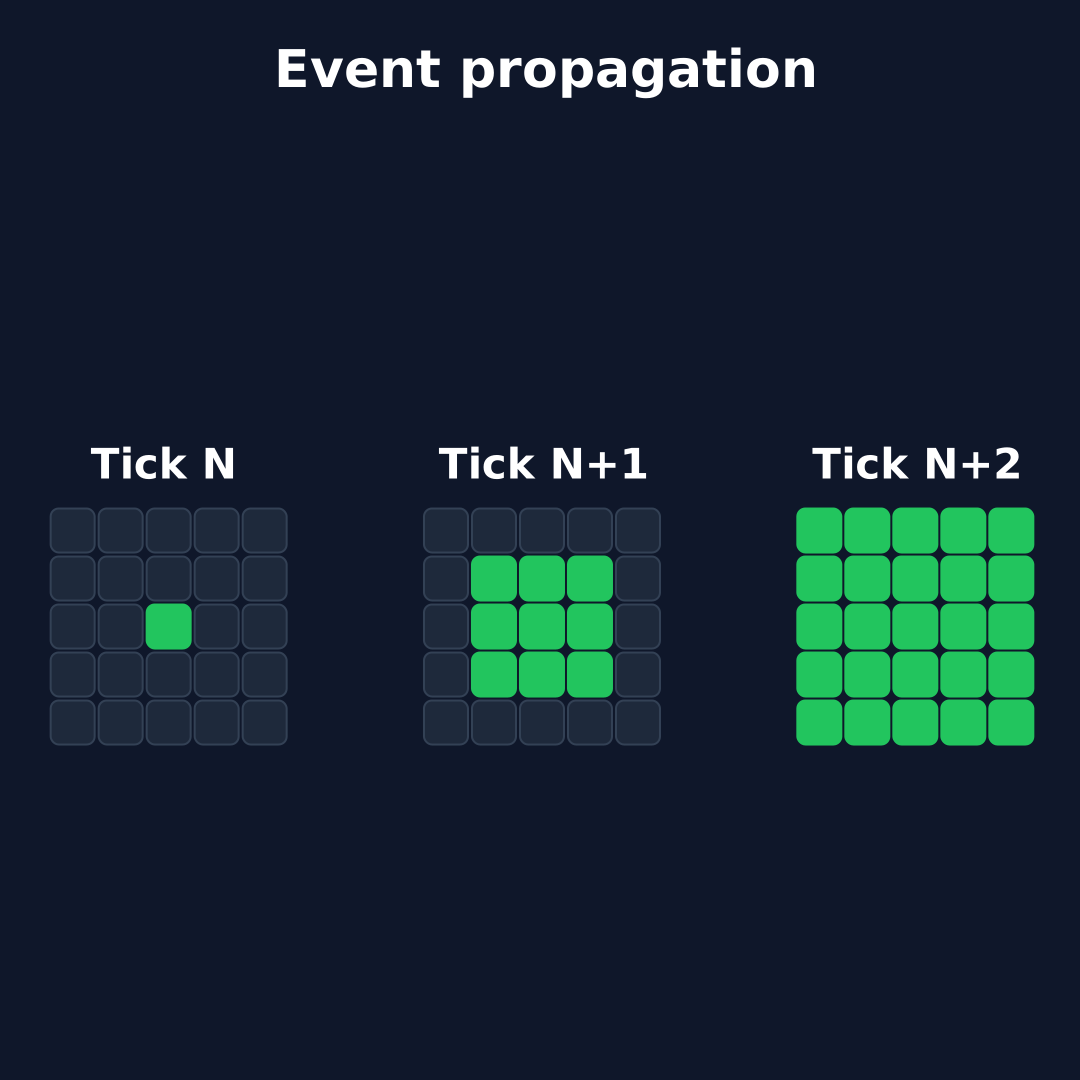
The world is partitioned into a 2D grid of chunks.
Each chunk runs multiple HiveShards.
A HiveShard receives events from:
- its own chunk
- the 8 surrounding chunks
Every tick it:
- Consumes events
- Updates local state
- Emits new events
Those new events become available during the next tick.
What does not happen
The important part is what DOES NOT happen:
- ❌ Information is not broadcast globally
Instead, information propagates through space.
- ✅ Information is local by default
- ✅ Local events stay local
- ✅ Global effects must propagate one tick at a time
HiveShard still executes in global lockstep:
- ❌ Not for global data synchronization
- ✅ But for global control-flow synchronization
This is much more feasible than full global data synchronization
Communication scales with locality rather than world size.
That's the principle HiveShard is built on.
Because at scale, computation is rarely the hardest problem.
Information exchange is.