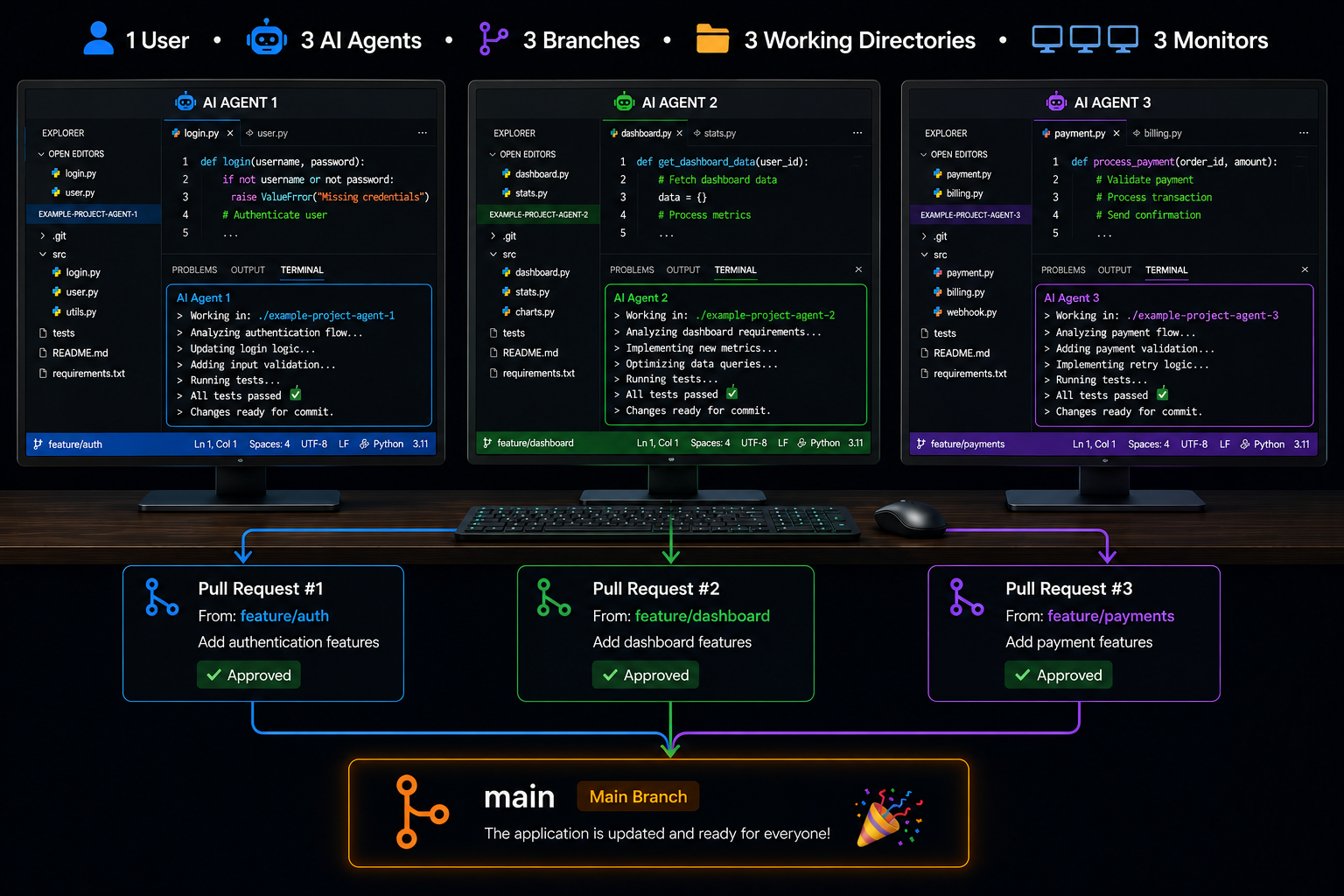
Working with multiple AI agents is chaotic.
The first bottleneck I ran into was not the model, the prompt, or even the codebase. It was attention. When several agents are running at the same time, each one has its own context, its own pending question, and its own idea of what "done" currently means. If all of that is hidden behind one laptop screen and a stack of tabs, you spend too much time switching between conversations and too little time actually supervising the work.
That changed how I think about physical workspace.
Multiple monitors are no longer just a convenience.
When each agent has a visible place to work, the whole setup becomes easier to reason about. I can see which agent is still coding, which one is waiting for input, and which one has finished enough work to review.
The point is not that every agent needs constant manual control. The point is that parallel work still needs continuous awareness.
With one monitor per agent chat, supervision becomes much less interrupt-driven. I do not need to remember to check a hidden tab. I can notice progress, pauses, and failures while continuing to work with another agent.
The practical difference is simple:
- Constantly switching tabs becomes less of the default.
- Losing track of which agent is doing what becomes less likely.
- Missing that an agent is waiting for input becomes easier to avoid.
The bigger realization was Git
At first, I tried letting multiple agents work in the same working directory. That fell apart quickly. Even when the agents were working on different tasks, they were still touching the same filesystem, the same IDE state, and often the same nearby files. One agent would format something another agent had just changed. Another would run tests against a half-finished state. The result was not collaboration. It was interference.
The fix was obvious once I stopped treating agents like chat windows and started treating them like developers.
Each agent needs its own workspace
- its own branch
- its own checkout
- its own IDE session
That gives every task a clean boundary. The agent can make changes, run tests, and build up context without stepping on another agent's work. If the task succeeds, it can become a pull request. If it fails, the damage is contained to that branch and that directory.
The workflow becomes familiar
new branch
    ↓
agent task
    ↓
implementation
    ↓
diff review
    ↓
pull request
    ↓
merge
That is the interesting part. Agentic coding does not replace the coordination model software teams already use. It leans on it.
Branches, working directories, pull requests, and code reviews already solve most of the coordination problems that appear when multiple contributors change the same system. AI agents make those problems show up faster because spinning up another contributor is almost free, but the underlying shape is not new.
Agentic coding simply gives this workflow more contributors.